
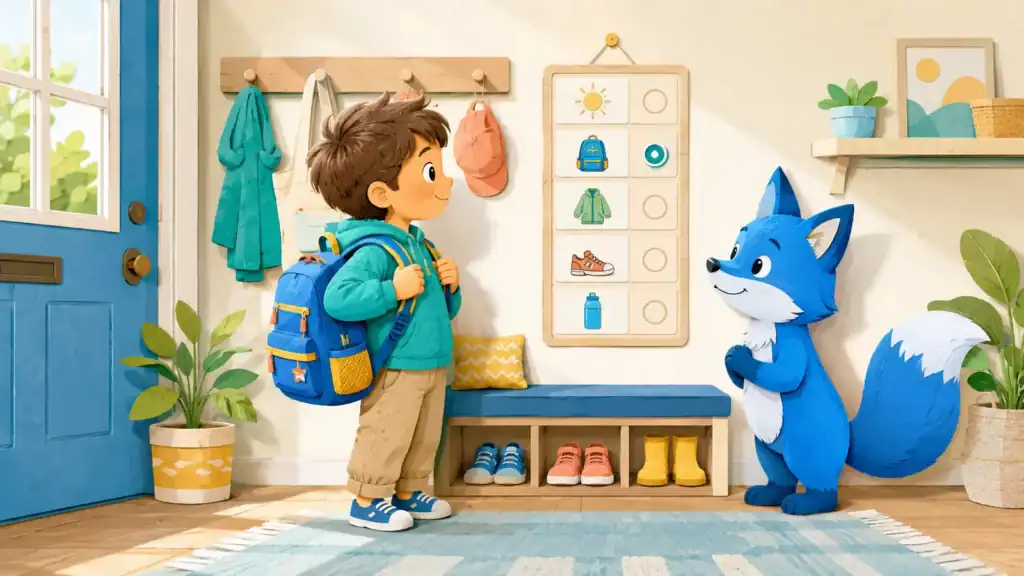
Independence rarely appears all at once. It grows through small, repeated moments: choosing clothes for the next day, remembering to put a lunchbox in a school bag or following the steps of an evening routine with a little less help.
The goal is not for children to do everything alone. Children still need connection, guidance and practical support. Over time, however, the way we help can change. We can show a new task, practise it together, offer a reminder when needed and gradually leave more room for the child to try.
If daily routines currently involve many repeated instructions, start small. A few thoughtful changes can make it easier for your child to understand what needs to happen and take a more active part.
Trying to hand over an entire morning or bedtime routine at once can feel overwhelming. Instead, choose one manageable responsibility your child is ready to practise.
It might be:
placing their school bag beside the door;
choosing clothes for the next morning;
brushing their teeth after breakfast;
putting their water bottle on the kitchen counter;
returning shoes to the same place each day.
Be clear about what the task includes and practise it at a predictable time. Once it has become familiar, you can add another small step.
A short responsibility that your child can genuinely manage is more useful than a long list that leads to repeated reminders. Small successes also give children a chance to see themselves as capable participants in family life.
A routine is much harder for a child to follow when it exists only in an adult’s head. During a busy morning, several spoken instructions can quickly become difficult to remember.
A simple visual sequence can make the next step easier to find. Depending on your child’s age, this might be a short written checklist, picture cards or a few prompts placed in the area where the routine happens.
Visual support does not complete the task for your child. It provides an external reminder, so your child does not have to hold every step in mind or wait for an adult to say what comes next.
Start by choosing just three or four steps that happen in the same order most days. Place the cards where your child will use them—not simply where they look neat. Walk through the routine together at first, pointing to each card as you go.
Once the sequence becomes familiar, pause before giving a verbal reminder. Allow your child a little time to look at the cards and work out what comes next.
The cards do not need to represent every small part of the day. A shorter routine that your child can follow is often more useful than a long chart that feels overwhelming. You can always add or change a card later as your child’s needs and responsibilities develop.
Before expecting a child to manage a task independently, make sure they have had a chance to learn how it works. A gradual approach can look like this:
Show it. Demonstrate the task and explain the important parts.
Do it together. Let your child take part while you provide support.
Prompt when needed. Offer a short cue instead of completing the task for them.
Let your child try. Stay available, but leave room for an independent attempt.
Stepping back does not have to happen on a fixed schedule. Your child may need more help on a tired morning, during a change in routine or when learning a more difficult step. Offering extra support on one day does not erase the progress already made.
“Get dressed, brush your teeth, pack your book and put on your shoes” may sound like one request, but it contains four separate tasks.
When your child needs verbal guidance, give one brief and specific direction at a time:
Please put on your clothes. When you are ready, come and show me.
Then allow enough time for your child to begin before adding another instruction.
Broad requests such as “Get ready!” may be clear to an adult who already knows the full routine. For a child, they may not explain where to start. A concrete first step makes action easier.
Children can practise independence by making age-appropriate decisions within a clear boundary. Two acceptable choices are usually enough:
“Would you like to get dressed before or after breakfast?”
“Would you like the blue shirt or the green one?”
“Shall we start with your school bag or your clothes?”
This offers a sense of participation without making the whole routine negotiable. Only offer options that genuinely work for you. If something must happen, it is clearer to state it calmly than to present it as a question.
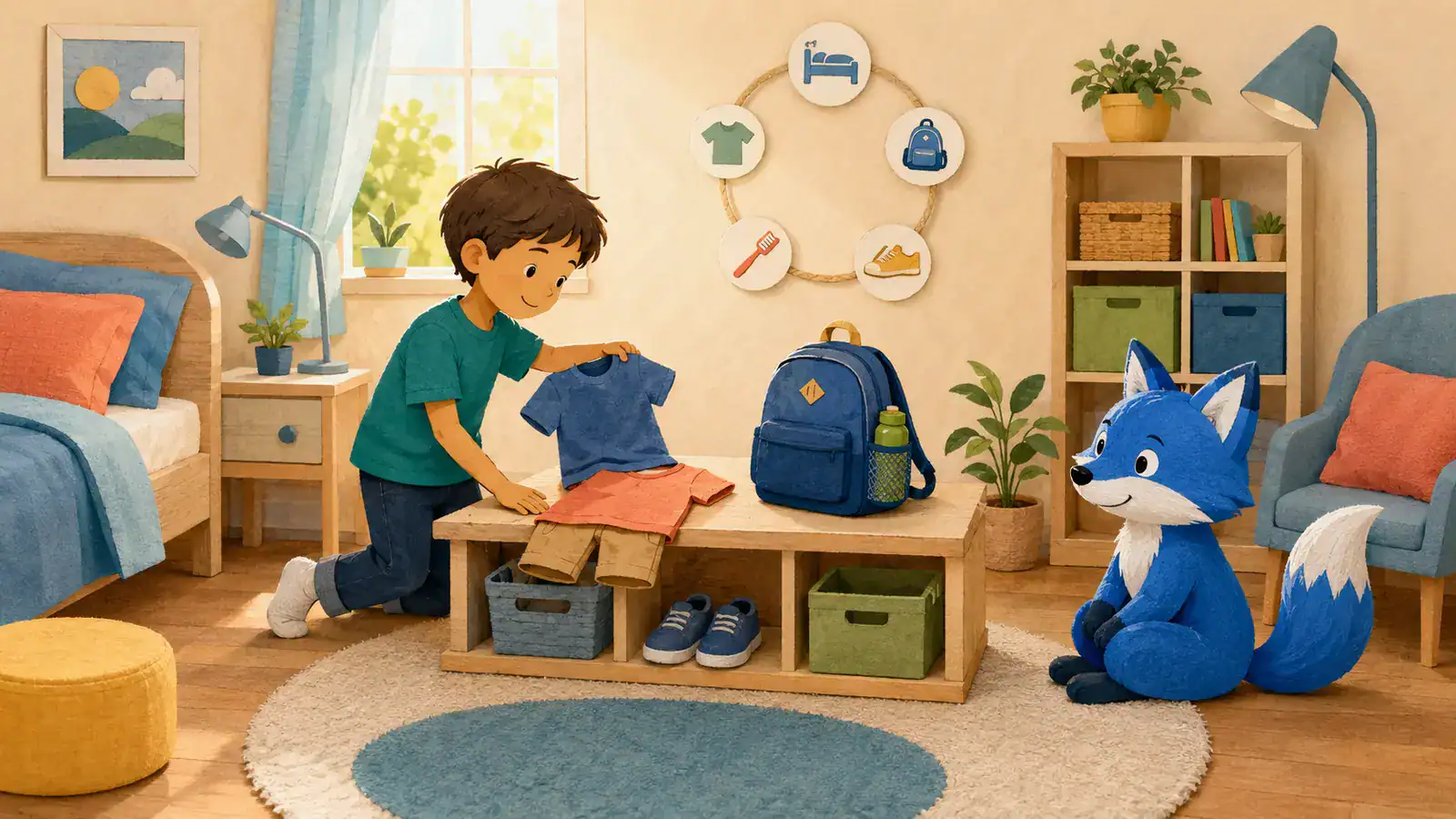
Sometimes a routine is difficult because the surroundings make the task unnecessarily complicated. Before deciding that your child is unwilling or forgetful, look at the practical setup.
Ask yourself:
Can my child reach the items they need?
Do shoes, bags and school supplies have a consistent place?
Is it obvious which items belong to this routine?
Are there unnecessary steps that could be removed?
Could one part be prepared the evening before?
A low hook for a school bag, a labelled basket or clothes placed within easy reach may remove the need for adult help at several points. The aim is not to eliminate every challenge. It is to create a fair opportunity for your child to try.
Children usually complete a new task more slowly than adults. If we take over every time the process becomes inconvenient, they have fewer opportunities to practise.
This does not mean waiting through a lengthy lesson when everyone is already late. Teach a new skill during a calmer part of the day, rehearse it when there is no immediate pressure and allow a little extra time when your child begins using it in the real routine.
Independence often looks slower before it begins to make daily life easier.
There will still be mornings when helping quickly is the sensible choice. What matters is that, across many ordinary days, your child has repeated opportunities to take part rather than being expected to master everything immediately.
Specific feedback helps a child recognise what they did successfully. Instead of relying only on a general “Good job,” you might say:
“You remembered to put your lunchbox in your bag.”
“You checked the routine card without waiting for a reminder.”
“You kept trying even when the zipper was difficult.”
This does not mean every small action needs applause or a reward. Simply noticing genuine effort, a useful strategy or growing consistency can help children understand their own progress.
Independence does not develop in a straight line. A task that felt easy on Monday may require more support on Friday.
Fatigue, time pressure, strong emotions, an unfamiliar situation or a longer-than-usual sequence can all affect how much help a child needs. Rather than treating this as failure, temporarily add support and reduce it again when the child is ready.
It can also help to ask whether the routine has become too long. Returning to three clear steps for a while may be more productive than insisting on a system that no longer feels manageable.
Children develop skills at different rates, and some routines may remain difficult even with patient practice and clear visual support. If everyday tasks regularly cause significant distress, or you have concerns about your child’s development, consider discussing them with your child’s teacher, pediatrician or another qualified professional.
Independence does not mean doing everything alone. It grows when children have clear steps, enough time to practise and a trusted adult who knows when to help—and when to leave a little room for trying.
Choose one small responsibility. Make the steps easy to understand. Practise together, then pause before stepping in. These ordinary moments may feel modest, but they are where confidence and everyday independence begin to grow.
Sources & Further Reading
Age-Appropriate Chores for Children – HealthyChildren.org, American Academy of Pediatrics
Your Checkup Checklist: 7 Years Old – HealthyChildren.org, American Academy of Pediatrics
Tips for Giving Directions – Centers for Disease Control and Prevention
A Guide to Executive Function – Center on the Developing Child at Harvard University
Calm, playful printable learning activities
Digital printable resources. No physical item is shipped. Purchases are completed securely through Etsy. © 2026 BlueFoxLearn. All rights reserved.