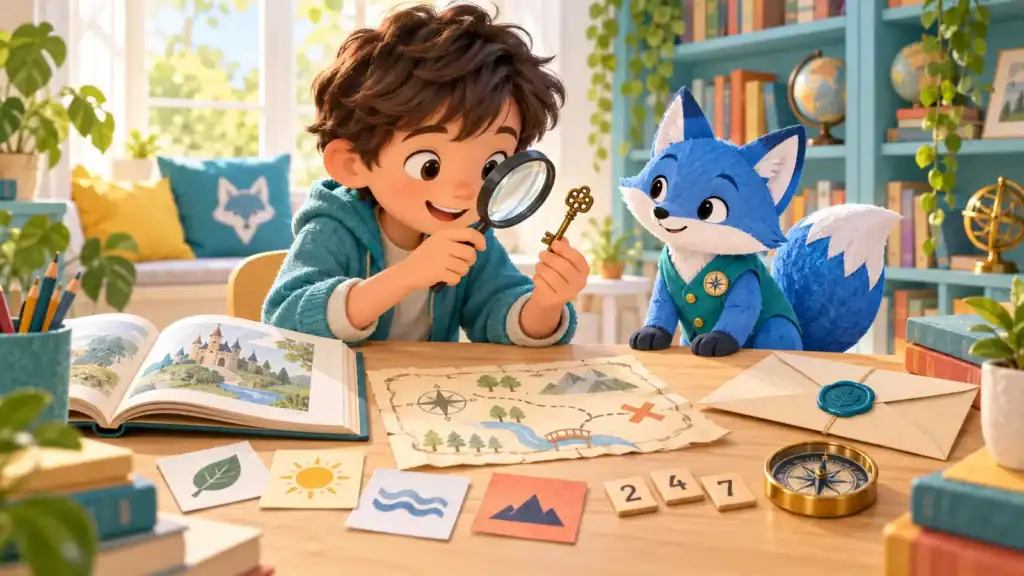
A missing key. A mixed-up message. A trail of numbers that leads somewhere unexpected.
For many children, a small mystery changes the feeling of an activity. Instead of completing questions simply because an adult assigned them, they have a reason to read carefully, test an idea and keep going: they want to find out what happened.
That does not mean every lesson needs costumes, elaborate props or a dramatic escape-room setup. A learning mystery can be wonderfully simple. It may begin with one unanswered question and a handful of clues that children must understand, organize and use.
When the mystery is well matched to the child, the story is not just decoration around the learning. It gives the reading, math or writing a meaningful job to do.
In a mystery-based activity, children use information to answer a central question. They might be looking for a missing object, identifying the correct location, decoding a secret word or deciding which explanation fits all the evidence.
Along the way, they may need to:
read short passages closely;
solve math problems;
notice patterns;
compare several possibilities;
separate useful clues from extra details;
make and revise predictions;
explain how the evidence supports their answer.
The mystery provides a structure, but the academic skills still matter. A child cannot reach the solution by enthusiasm alone. They must use what they know.
Curiosity often begins when we know enough to recognize that something is missing—but not enough to know the answer yet.
A title such as The Missing Museum Key, immediately creates an unanswered question. Where is the key? What happened to it? Which details will matter? The child now has a reason to look for information.
Research with children and adolescents suggests that curiosity and interest can support learning and memory, although they are not identical and do not affect every learner in exactly the same way. In practice, this means a mystery can help invite attention, but the activity still needs clear instructions, appropriate content and a reachable solution.
Too little information can feel random. Too much can remove the reason to investigate. A good mystery sits between the two: the child understands the goal and has enough evidence to begin, while the final answer remains just out of reach.
In a traditional question-and-answer activity, children may wait for an adult to confirm each response. A mystery changes the role slightly. The child becomes the person who must make sense of the evidence.
They are not only asking, “What answer does the worksheet want?” They are also asking:
“What do I know so far?”
“Which clue should I use next?”
“Does this idea fit everything I have found?”
“Do I need to change my prediction?”
This sense of participation does not require complete independence. Younger children may solve the mystery with a parent, teacher or partner. The important shift is that their ideas help move the investigation forward.
Children sometimes understand how to perform a skill but do not see why it matters. A mystery creates a small, immediate purpose.
A reading passage contains information needed to eliminate a location. A subtraction problem reveals a code number. A vocabulary word changes the meaning of a witness note. A written explanation proves that the chosen answer is supported by evidence.
The activity still provides practice, but the practice is connected to an outcome the child cares about.
This is especially useful when several short tasks lead toward one larger goal. Instead of feeling like an unrelated collection of questions, the parts belong to the same investigation.
Mysteries reward careful attention. A small detail that seems unimportant at first may become useful later, so children have a natural reason to reread.
They may need to distinguish between:
what the text states directly;
what they can reasonably infer;
what they predicted before finding enough evidence;
what still remains unknown.
These distinctions matter beyond mystery stories. Strong reading comprehension involves connecting ideas, monitoring understanding and using information from a text—not simply remembering isolated sentences.
A helpful clue tracker can make this thinking visible. For example:
Clue Where I found it What it might mean Is it impontant?
The window was still locked Part 2 No one left through the window Probably
Children do not need to fill in a large chart for every story. Even a short conversation about one clue can help them explain how they moved from information to conclusion.
Guessing can be part of the fun, but a learning mystery should not end with a lucky guess. Children need opportunities to update their thinking as new information appears.
You can ask:
“What is your best idea right now?”
“Which clue supports it?”
“What new information could change your mind?”
“Does the latest clue still fit your theory?”
Changing an answer is not failure. It shows that the child noticed new evidence and used it.
This is a valuable habit in reading, mathematics, science and everyday problem-solving. We form an idea, test it against the available information and revise it when the evidence no longer fits.
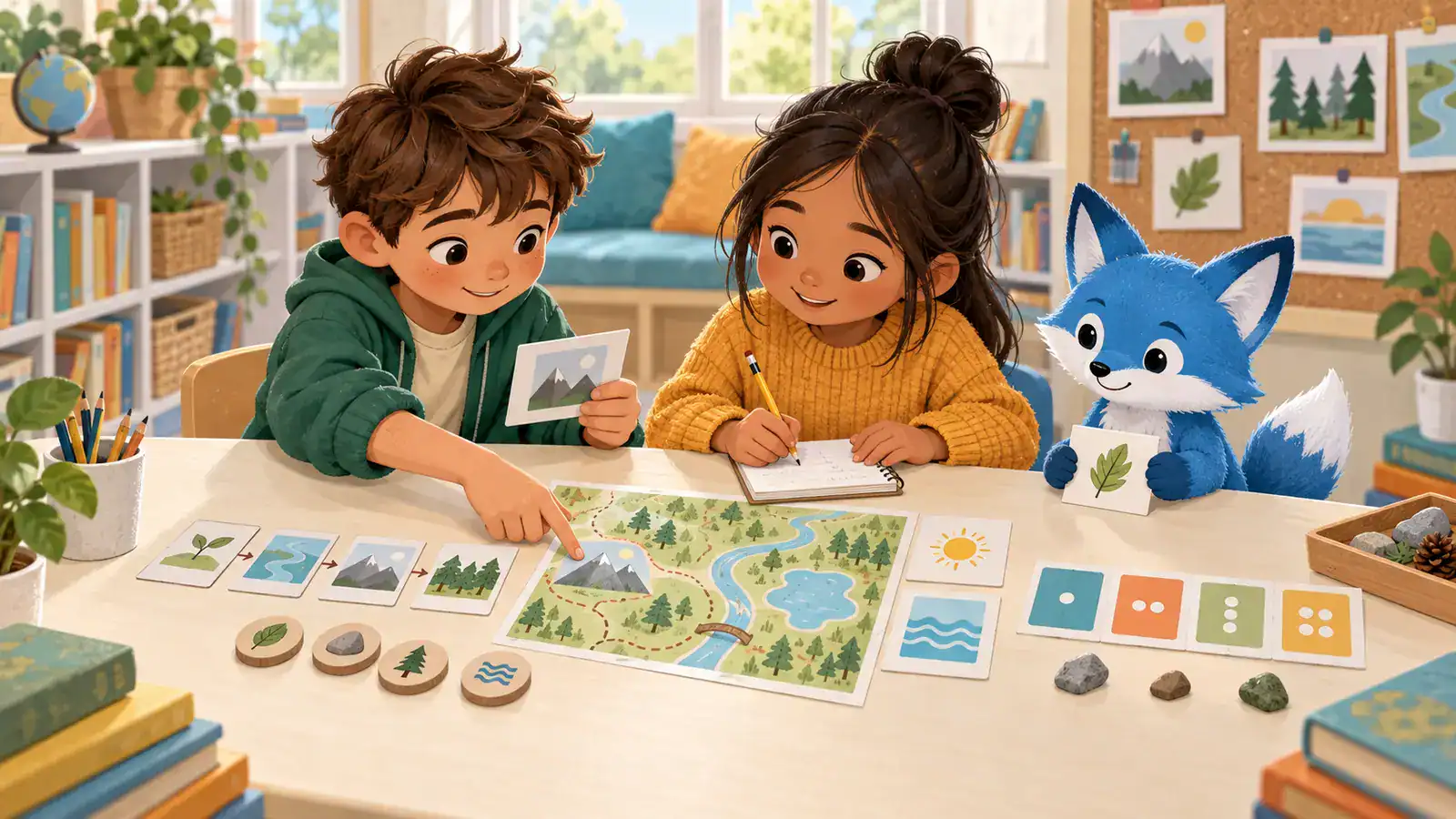
Real investigations rarely stay inside one school subject, and printable mysteries do not have to either.
A child might:
read a note for meaning;
put events in sequence;
calculate a missing number;
use a map or simple diagram;
identify a pattern;
write an evidence-based conclusion.
The skills remain recognizable, but the child experiences them as parts of one task.
This cross-curricular structure can be especially engaging for children who are less interested in practising a skill in isolation. A reluctant writer may be willing to record a detective conclusion. A child who avoids word problems may be more interested when the answer unlocks a clue.
The theme should never hide the learning objective, however. If the story becomes so complicated that children cannot tell what they are meant to practise, the mystery is adding cognitive load rather than useful context.
A mystery offers a visible destination. Each completed task moves the child closer to an answer, so persistence has an understandable payoff.
That does not mean frustration automatically becomes productive. An activity that is far above the child’s reading or math level may still feel discouraging, however attractive the theme appears.
The best challenge is one the child cannot solve instantly but can approach using familiar skills, helpful tools and a reasonable amount of support.
If a child gets stuck, offer a prompt that keeps the thinking with them:
“Which clue have you not used yet?”
“Can we cross out anything that no longer fits?”
“Where could we look again?”
“Would it help to draw or organize the information?”
If the problem remains too difficult, reduce the number of choices, read a section together or model how to use one clue. The goal is not to protect the solution at all costs. The goal is to help the child experience a genuine path from uncertainty to understanding.
Mysteries invite conversation because two people can examine the same clues and initially reach different conclusions.
When children solve with a partner, sibling, parent or small group, they can practise phrases such as:
“I think this because…”
“My evidence is…”
“That clue might mean…”
“I agree with part of your idea, but…”
“We should check…”
These exchanges make reasoning audible. They also give adults a chance to notice whether a child misunderstood the text, overlooked a detail or has a strong idea they cannot yet explain clearly.
Collaboration works best when one confident participant does not take over the entire case. Give each child time to inspect the information, or assign small roles such as reader, clue recorder and answer checker.
The reveal is exciting, but it should not be the only important moment. After solving the mystery, take a minute to look back at the thinking process.
Ask:
“Which clue helped you most?”
“Did any clue change your mind?”
“What strategy would you use in another mystery?”
“How did you check that your final answer fit?”
“Was any information interesting but not necessary?”
This brief reflection helps the child name a strategy that can be used again. It also shifts the focus from merely being right to understanding how a conclusion was reached.
A strong theme can attract attention, but appearance alone does not make an activity effective. Before choosing a printable mystery, look beyond the cover.
The reading, calculations and instructions should be manageable for the intended child. The activity may include a challenge, but it should not quietly depend on skills the child has not yet learned.
The final answer should follow from the information provided. Children should not need to read the creator’s mind or choose between several equally possible solutions.
Children need to know what to read, record or solve next. Decorative elements can create atmosphere, but they should not compete with the instructions or important information.
Some children enjoy spooky cases; others prefer a library, museum, animal, nature or school adventure. A mystery does not need danger or frightening characters to feel exciting.
A clear answer key, adult guide or optional hint can prevent the activity from turning into an argument when a child gets stuck.
You can create a tiny learning mystery at home or in the classroom without preparing a full packet.
Choose a familiar object and hide it in an appropriate place.
Write three short clues that use a skill your child is practising.
Let each answer eliminate a location or reveal part of the final message.
Ask the child to explain which clue led to the solution.
For example, a child might solve three addition problems. Each correct answer matches a letter, and the letters spell DESK. The final step is to check under the desk and explain how the code revealed the location.
Keep the first mystery short. Three clear clues that lead to a satisfying solution are better than a long investigation that becomes difficult to manage.
Children may be drawn to mysteries because they promise an answer. But the most valuable part happens before the reveal: observing, wondering, reading carefully, organizing information, testing possibilities and explaining why a conclusion makes sense.
A well-designed mystery does not disguise learning so completely that the skill disappears. It gives the skill a purpose.
The child is not simply finishing another page. They are using what they know to solve something—and that can make learning feel active, meaningful and worth continuing.
Sources & Further Reading
Calm, playful printable learning activities
Digital printable resources. No physical item is shipped. Purchases are completed securely through Etsy. © 2026 BlueFoxLearn. All rights reserved.