
Autumn often brings a welcome change of pace. The air feels cooler, leaves begin to change and afternoons naturally invite a little more time indoors. But those quieter hours do not have to become another carefully planned lesson—or automatically turn into extra screen time.
Some of the richest learning can begin with ordinary seasonal moments: sorting leaves after a short walk, measuring ingredients for a warm snack, inventing a story about an acorn or solving a small mystery at the kitchen table.
The goal is not to fill every free minute with an educational activity. Children need rest, unstructured play and time to be bored, too. Instead, it can help to keep a few simple ideas ready for the days when a child wants something to do and an adult would like an alternative that feels calm, purposeful and manageable.
Here are ten screen-free autumn learning ideas that use the season as a starting point for observation, language, math, creativity and problem-solving.
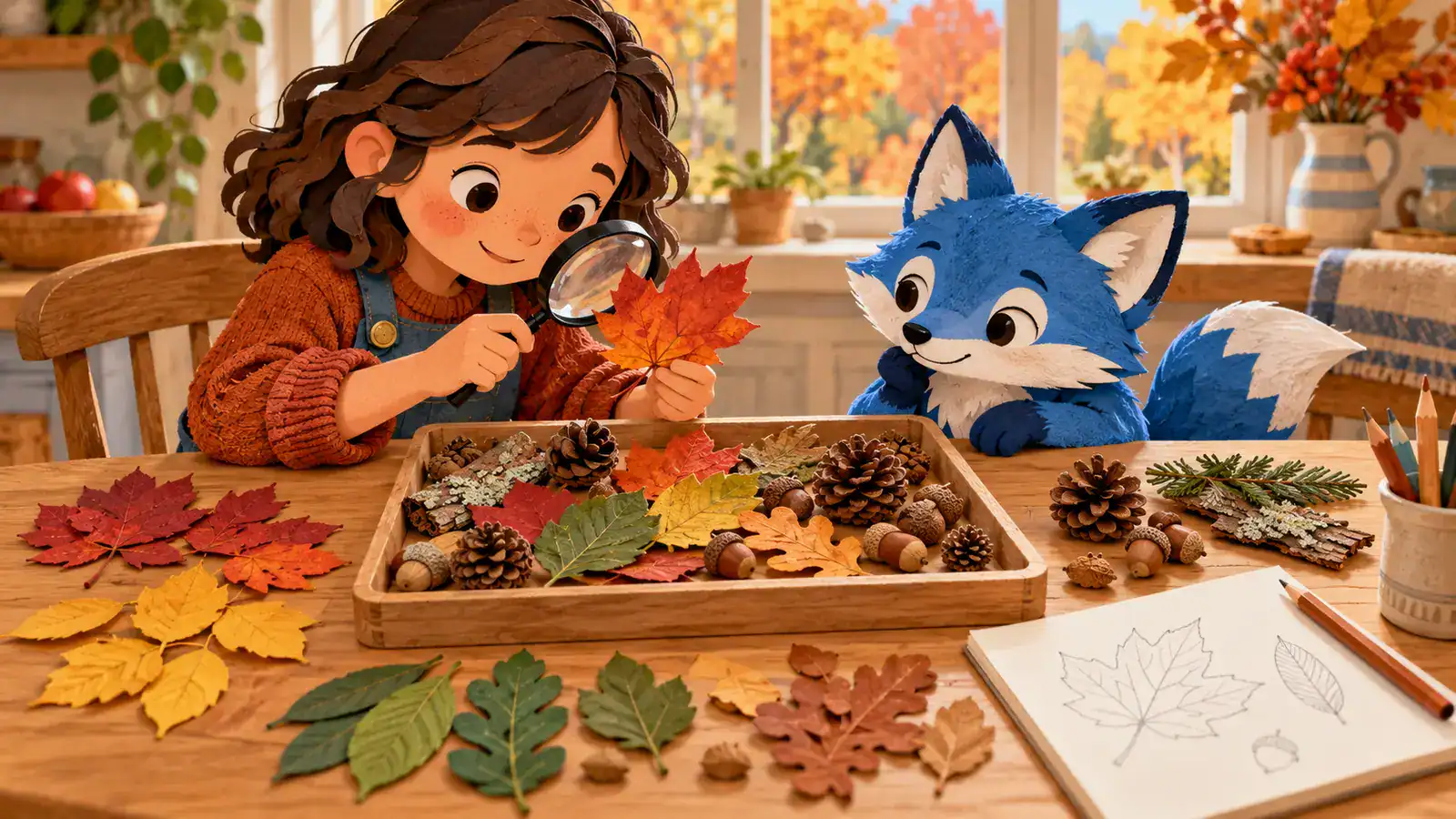
After a walk, place a few safe natural finds on a tray: perhaps a fallen leaf, an acorn, a small pinecone, a feather or a piece of bark. Children do not need a long worksheet to study them. A magnifying glass, blank paper and a pencil are enough.
Invite your child to choose one object and look closely:
Children can sketch the object, label its parts or write three observations. Younger children may dictate their ideas to an adult.
This is a gentle way to practise careful noticing and descriptive language. It also helps children distinguish between an observation—what they can actually see, feel or measure—and an idea about why something might be that way.
Use only items that are safe to handle, and check local rules before collecting anything. In many places, the best choice is to draw or photograph natural finds and leave them where they are.
A small group of leaves, acorns or paper cutouts can become an open-ended math activity.
Ask your child to sort the objects in any way that makes sense. They might group leaves by color, size, shape or edge. Then ask, “How did you decide?” There may be more than one sensible answer, and explaining the rule is part of the mathematical thinking.
You can extend the activity by inviting your child to:
For older elementary children, try a question with no single required method: “We found 24 leaves. How many different equal groups can you make?”
The materials may look seasonal, but the underlying ideas—classification, comparison, pattern and number relationships—are useful throughout the year.
A walk does not need to be long or take place in a forest. A yard, neighborhood street, school grounds or local park can provide plenty to notice.
Choose one sense at a time and look for details:
Taste should be saved for known, adult-approved foods rather than anything found outdoors.
Back inside, ask your child to record one memorable detail from the walk. They might draw it, write a caption, add it to a nature journal or turn it into the first sentence of a story.
The National Association for the Education of Young Children suggests activities such as nature scavenger hunts, observation and sketching as ways for families to explore outdoors. Even when the weather limits outdoor time, natural materials can be brought indoors for sorting, counting, drawing and close observation.
Making a simple autumn snack can provide real reasons to read, count and measure. Try apples with cinnamon yogurt, oatmeal with fruit, pumpkin muffins or another familiar family recipe.
Depending on your child’s age, they can help:
You do not need to turn every movement into a question. Choose one or two skills that fit naturally, then enjoy making and eating the food together.
Cooking also makes room for useful mistakes. If the wrong measuring spoon is selected, pause and compare rather than immediately correcting it. A short question—“Does this match the amount in the recipe?”—can help the child check the choice independently.
Always match kitchen responsibilities to the child’s age and supervise heat, sharp tools and food-safety steps closely.
Mysteries give children a reason to read details carefully and connect information. You can create one without elaborate preparation.
Hide a small paper leaf, bookmark or friendly note somewhere in the room. Write three clues that lead to the hiding place. For example:
The answer might be beside the shoe basket.
For younger children, use picture clues or positional words such as under, beside and behind. Older children can solve number clues, eliminate several possible locations or write a new mystery for someone else.
The important part is that each clue matters and the final answer can be explained. Afterward, ask: “Which clue helped you most?” or “How did you rule out the other places?”
If your child enjoys this kind of purposeful problem-solving, you may also like our article Why Kids Love Learning Through Mysteries and Clues.
Place three seasonal objects or picture cards in a bag. A child might draw a fox, a lantern and a red leaf—or an acorn, a boot and a mysterious map.
Use all three to invent a story. A simple structure can make starting easier:
Children can tell the story aloud, act it out, draw it as a sequence or write it. If a blank page feels intimidating, take turns adding one sentence each.
There is no need to correct every grammar or spelling detail while a child is generating ideas. Decide whether the moment is for storytelling or editing. Those are related skills, but they do not always need to happen at the same time.
Autumn offers changes that can be observed over several days or weeks. Choose one small question to follow:
Before beginning, ask your child what they predict. Then choose a consistent way to record the information. A tally chart, number line, table or simple bar graph may be enough.
At the end, look at the record together:
The value is not in producing perfect scientific data. It is in seeing that questions can be explored through repeated observation and an organized record.
A pretend farm stand, pumpkin patch shop or woodland café can combine imagination with practical reading and math.
Use play food, clean containers, handmade signs and paper money. Children can create a name for the shop, label products, write a short menu or set simple prices.
During play, they might:
Keep the numbers suitable for the child. A beginning counter may use prices from 1 to 5, while an older child can work with two-digit totals or a small budget.
Pretend play is most useful when the story remains enjoyable. The math should support the play, not interrupt it every few seconds.
On busy days, choosing an activity can take more energy than doing one. A small basket can make a quiet option visible and easy to begin.
You might include:
The basket does not need to be large, new or changed every day. In fact, too many choices can make it harder to start. A few carefully selected materials are enough.
Try setting it out at a predictable time—after breakfast on a weekend, during a quiet afternoon or while an adult prepares dinner. Your child can choose one item, complete a short activity or simply explore.
The American Academy of Pediatrics encourages families to consider what media may be crowding out, including reading, drawing, movement, outdoor play and family conversation. A ready-to-use basket does not have to replace screens completely; it simply gives children another accessible choice.
Conversation can be a learning activity, too. Write a few questions on slips of paper and place them in a jar. Take turns choosing one during a snack, car ride or cozy evening.
Try questions such as:
There may be no single correct answer. The aim is to explain an idea, listen to another person and build on what someone else says.
For children who are reluctant to answer, offer two starting choices or answer first yourself. A playful question works best as an invitation, not a test.
A screen-free activity does not need to be elaborate, perfectly themed or worthy of a photograph. It also does not need to last an entire afternoon.
Ten focused minutes can be enough for a child to notice something new, test an idea or become absorbed in a story. On another day, the same invitation may grow into an hour of play. Both outcomes are fine.
A few principles can help:
After a demanding school day, a child may need movement, comfort or free play more than a structured task. Save the multi-step activity for a day when there is enough attention for it.
Instead of asking, “What do you want to do?” try: “Would you rather make a leaf pattern or solve a mystery?” Two manageable options can make starting easier.
Paper, pencils, measuring cups, storybooks, recycled containers and safely gathered natural materials can support many kinds of learning. Seasonal learning does not require a new supply collection.
Not every activity needs written proof or a finished product. A child who sorts, compares, imagines, builds and explains is already doing meaningful thinking.
If interest fades, it is fine to leave the activity unfinished. The goal is not to complete a list. It is to create an inviting space for curiosity and connection.
Cozy autumn days can hold many kinds of learning: the close observation of a leaf, the logic of a clue, the measurement in a recipe and the imaginative leap that begins a new story.
Choose one idea that suits your child and the time you have. Keep the materials simple. Join in when connection would help, then leave room for your child to make decisions and take the activity in an unexpected direction.
Screen-free learning does not have to mean doing more. Often, it simply means making space for children to notice, move, talk, create and wonder.
Sources & Further Reading
Calm, playful printable learning activities
Digital printable resources. No physical item is shipped. Purchases are completed securely through Etsy. © 2026 BlueFoxLearn. All rights reserved.