When a child says, “I’m just bad at math,” the answer is rarely another long page of problems.
Practice matters, and worksheets can be useful when they are focused, well matched to the skill and used for a clear purpose. But math confidence grows from more than completing a certain number of questions. Children also need chances to make sense of problems, explain their thinking, try a different strategy and discover that getting stuck is not the same as being incapable.
If math has started to feel tense in your home, you do not need to turn every afternoon into a lesson. Small changes in the way you talk, play and solve everyday problems together can help your child build a calmer, more capable relationship with math.
Math confidence does not mean answering every question quickly or never making a mistake. A confident learner can say:
“I don’t understand this yet, but I can begin somewhere.”
“I can try another way.”
“I can explain what I know.”
“I can ask for help without feeling ashamed.”
“A mistake can show me what to check next.”
This matters because a child may know more mathematics than they can show when they feel rushed, watched or afraid of being wrong. The goal is not to remove every challenge. It is to make challenge feel manageable enough that the child can stay engaged.
Children often turn one difficult experience into a broad conclusion:
“I’m not a math person.”
“Everyone else is faster than me.”
“I always get these wrong.”
Before correcting the statement, try to find the specific difficulty hiding inside it. You might ask:
“Which part started to feel confusing?”
“Can you show me the last step that made sense?”
“Is the problem difficult to understand, or is the calculation the difficult part?”
“Would it help to draw it, use objects or say it aloud?”
Specific problems are easier to work with than a fixed label. “I am bad at math” feels permanent. “I am still learning how to regroup when I subtract” points to a skill that can be practised.
Fast recall can be helpful, but speed is not the same as mathematical understanding. When speed becomes the main sign of success, a thoughtful child may begin to believe that taking time means they are not good at math.
Try asking questions that make thinking visible:
“How did you know?”
“Can you solve it another way?”
“What do you notice?”
“What would be a reasonable answer?”
“How could you check it?”
For example, if your child solves 8 + 7, the conversation does not have to end at 15. They might explain that 8 needs 2 to make 10, so they split 7 into 2 and 5. Another child may think of 7 + 7 and add one. Both strategies reveal useful number sense.
You do not need to ask every question every time. One calm prompt is enough to show that the method matters as well as the answer.
Math can quickly feel overwhelming when several needs are mixed together. A page may require a child to read instructions, understand new vocabulary, recall facts, choose an operation, organize written work and stay focused—all at once.
Choose one small goal for a short practice session. It might be:
finding pairs that make 10;
reading a word problem and identifying what is being asked;
practising one multiplication family;
comparing two-digit numbers;
explaining one solution clearly.
A narrow goal makes progress easier to notice. It also helps you choose an activity that practises the intended skill without adding unnecessary difficulty.
Ten purposeful minutes can be more useful than a long session that ends with both adult and child frustrated.
Telling children that “mistakes are good” can sound reassuring, but it becomes meaningful only when we show them what to do with a mistake.
Instead of immediately replacing a wrong answer with the correct one, try:
Ask the child to explain what they did.
Find the last step that still made sense.
Compare the strategy with the information in the problem.
Change or check one step at a time.
You might say:
“Your first step works. Let’s look at what happened after that.”
or:
“This answer seems larger than we expected. What could we check?”
The message is not that accuracy is unimportant. The message is that an incorrect answer is something we can investigate—not proof that the child cannot learn the skill.
Everyday situations give math a purpose without feeling like an extra assignment. Look for short opportunities that fit naturally into what you are already doing:
compare prices or quantities while shopping;
estimate how many cups will fit on a shelf;
divide snacks fairly;
double or halve a simple recipe;
work out how many minutes remain before leaving;
measure a box, a plant or a piece of furniture;
look for patterns in tiles, buildings or nature;
plan how to spend a small pretend budget.
Keep the conversation light. You do not need to turn every real-life moment into a quiz. Sometimes simply wondering aloud—“We need 12 strawberries for four plates. How could we share them?”—is enough to invite mathematical thinking.

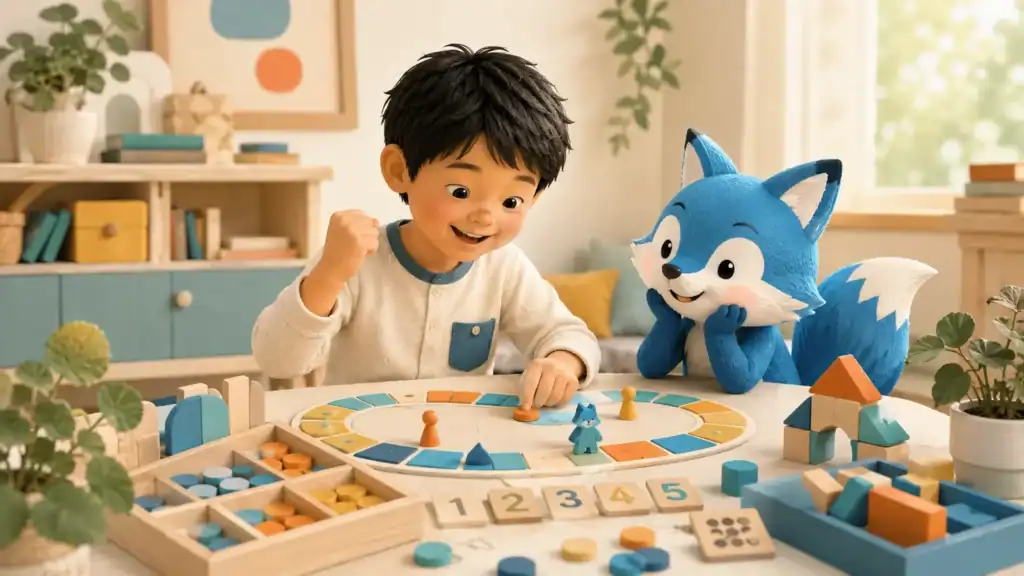
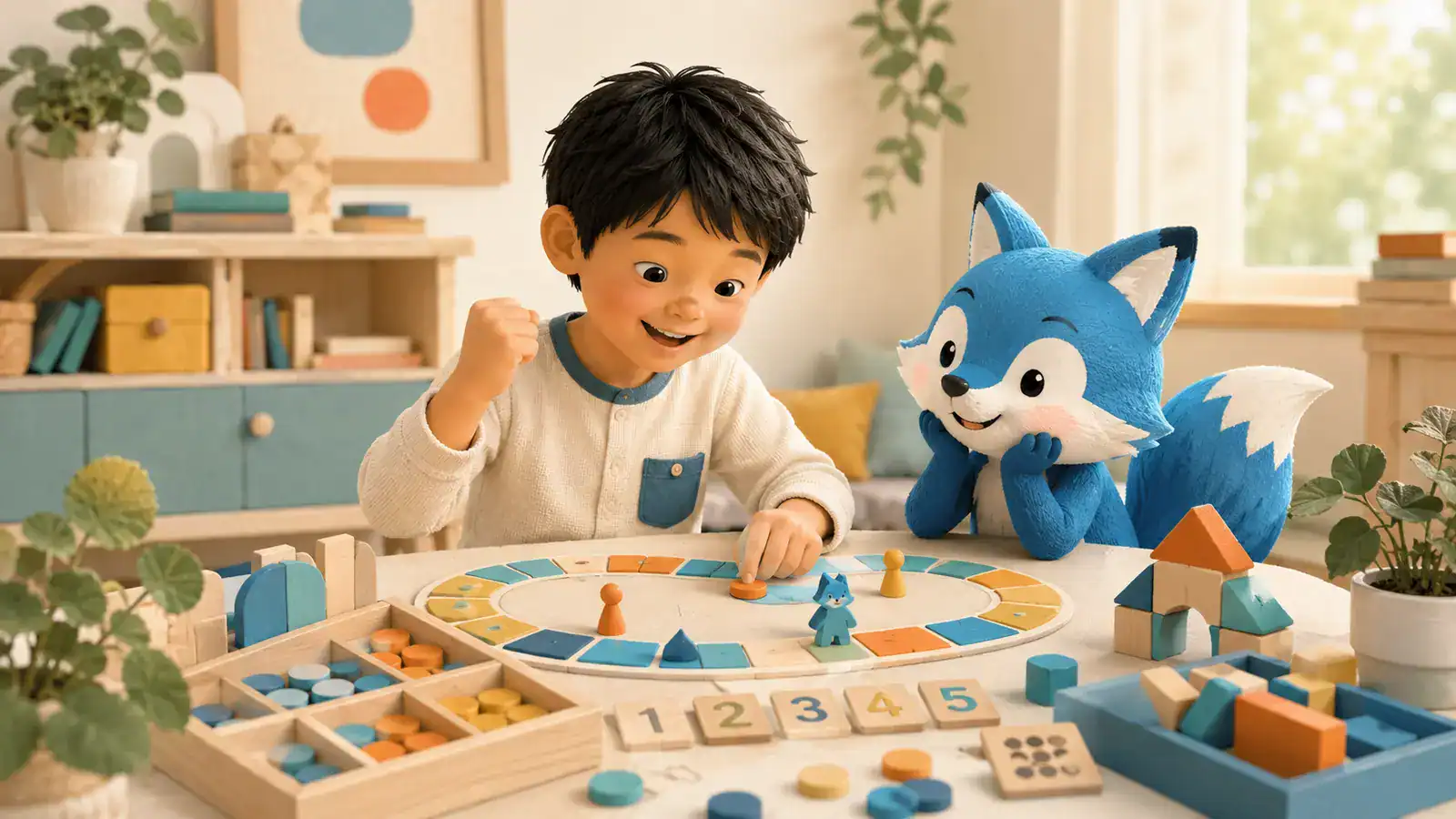
Games can create repeated practice while shifting attention away from “being tested.” Dice, cards, dominoes, puzzles and board games naturally involve counting, comparing, planning, recognizing patterns and making decisions.
Choose a game that matches the skill your child needs. A complicated game with too many rules may add frustration instead of reducing it. Keep early rounds cooperative or allow everyone to talk through possible moves while the rules become familiar.
You can also adjust a familiar game:
roll two dice and add or multiply the numbers;
turn over two number cards and find the difference;
build a target number in more than one way;
estimate before counting a collection;
explain which move would earn the most points.
The most useful game is not necessarily the most educational-looking one. It is the one your child is willing to play again.
Some children engage more easily when a calculation is part of a larger purpose. A missing code, a trail to follow, a pretend shop or a clue to test gives them a reason to use the math.
Story-based activities can also encourage children to slow down and ask:
What information do I have?
What am I trying to find?
Which details matter?
Does my answer fit the story?
The story should support the mathematics, not bury it under too much reading or decoration. A clear problem, manageable amount of text and visible steps help keep the activity playful without making it confusing.
This is one reason we use adventures, clues and real-life play in many BlueFoxLearn activities: the math still matters, but it has a job to do.
When a child hesitates, it can be tempting either to give the answer immediately or to insist that they work it out alone. A middle step is often more helpful.
Try offering the smallest prompt that allows the child to continue:
“What do you know already?”
“Could you draw the situation?”
“Which operation might fit?”
“Would smaller numbers help you see the pattern?”
“Can you find a similar problem you solved before?”
Then pause. Children sometimes need more thinking time than adults expect.
If the child is becoming increasingly upset, stop and reduce the difficulty. Productive effort and distress are not the same thing. You can return to the skill with clearer instruction, concrete objects, a shorter task or support from the child’s teacher.
Praise such as “You’re so smart” may feel encouraging, but specific observations give children more useful information about what helped them succeed.
Try noticing:
“You drew a picture when the words felt confusing.”
“You checked your answer in a different way.”
“You stayed with the problem and changed your strategy.”
“You remembered how making 10 helped last time.”
“You explained your thinking clearly.”
This does not mean praising every calculation. It means helping your child recognize the actions they can use again.
It is also worth noticing progress that is not visible in a score: beginning without avoiding the task, asking a clearer question, recovering after a mistake or needing one reminder instead of three.
Worksheets are not the enemy of math confidence. A clear, well-designed page can help a child practise a specific skill, organize their thinking or show what they understand.
The difficulty comes when more pages become the automatic answer to every struggle. Repetition cannot fix a misunderstanding that has not yet been identified, and a child who is already discouraged may experience a longer assignment as evidence that math is a punishment.
Before choosing another page, ask:
Does my child understand the idea and simply need a little practice?
Is the amount manageable?
Is the reading level appropriate?
Can my child see or check progress?
Would objects, a game, a drawing or a conversation make the concept clearer first?
A useful printable should have a purpose. Sometimes that purpose is direct practice. At other times, it may be solving a mystery, playing a game, making a decision or explaining an idea.
Children learn mathematics at different rates, and confidence-building activities do not replace clear teaching or individualized support. If math regularly causes significant distress, if your child continues to struggle with foundational skills despite appropriate instruction and practice, or if you are concerned about a possible learning difficulty, begin by talking with the child’s teacher. A pediatrician or another qualified professional can also help you decide whether further evaluation or support may be useful.
Math confidence is built through many small experiences: a problem that finally makes sense, a strategy the child can explain, a game they want to play again or a mistake they learn how to repair.
You do not have to remove worksheets from your child’s learning. You also do not have to rely on them for every kind of practice. Combine short, purposeful written work with conversation, games, real-life questions and meaningful challenges. The aim is not to make math effortless. It is to help your child experience themselves as someone who can think, try, learn and improve.
Sources & Further Reading
Engaging Families for Math Success – Institute of Education Sciences
Teaching Math to Young Children for Families and Caregivers – Institute of Education Sciences
Brain-Building Through Play – Center on the Developing Child at Harvard University
Learning Disabilities & Differences: What Parents Need to Know – HealthyChildren.org
Calm, playful printable learning activities
Digital printable resources. No physical item is shipped. Purchases are completed securely through Etsy. © 2026 BlueFoxLearn. All rights reserved.